© 2025. All rights reserved.
 Site created with
Hakyll.
Site created with
Hakyll.
Modified theme
lanyon-hakyll
based on
Lanyon.
© 2025. All rights reserved.
Site created with
Hakyll.
Modified theme
lanyon-hakyll
based on
Lanyon.
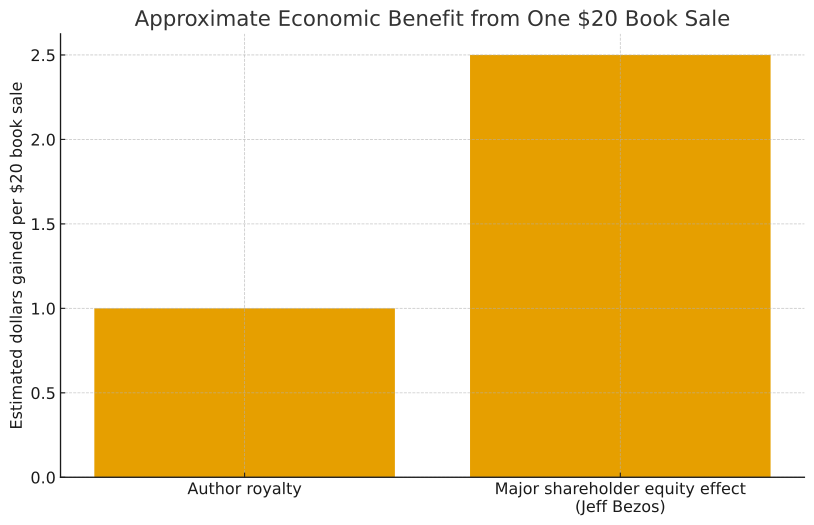
Buying my book may look like a direct exchange — twenty widgets for something I made. It isn’t. Perhaps one widget reaches me; the rest flow mainly to Amazon’s shareholders. What you are really paying for is the privilege of remaining inside Amazon’s enclosed digital territory, where a levy of over 50% is extracted for the benefit of its owners.
The retailer (e.g. Amazon) typically receives a substantial portion of the list price in exchange for things like maintaining the online marketplace, processing payments, warehousing and fulfillment, etc. For academic paperbacks, the retailer’s share is often on the order of 40–55% of the list price. For a book selling at $20, this corresponds roughly to $8–$11 per copy. These revenues contribute to Amazon’s overall business operations and, ultimately, to its corporate valuation and shareholders. If you trade with the middleman Amazon, then most of your widgets go to the people who own the most Amazon shares.
For example: I have estimated that I, individually, contribute $1000 annually to Bezos’ net worth. I don’t choose explicitly to do it, and and I even try to avoid it. But what can I do? I have to go to work in the morning, get dinner on the table, etc.
After the retailer’s share, the remaining revenue goes to the publisher, in this case Princeton University Press. From this revenue, the Press covers costs such as manuscript acquisition and peer review, copyediting and typesetting, cover design, etc. As a nonprofit university press (i.e. without shareholders), Princeton University Press uses its revenue to support ongoing publishing activities and future scholarly works.
Authors are typically compensated through royalties based on a percentage of the publisher’s net receipts, rather than the full list price. For academic paperbacks, this commonly results in author earnings of approximately $1 per copy sold, though the precise amount depends on contractual terms, format, and sales channel. In proportional terms, this is often roughly 5% of the retail price.
Out of a $20 paperback sale:
$8–$11 → Amazon
$6–$9 → Princeton University Press
$1 → the author
The precise allocation varies, but this general structure is typical for academic books sold through large online retailers.